Ashraful Haque
Risalah.tv Academy
Teaches Numerical Patterns in the Qur’an at Risalah Academy. Open the teacher details to see their other courses.
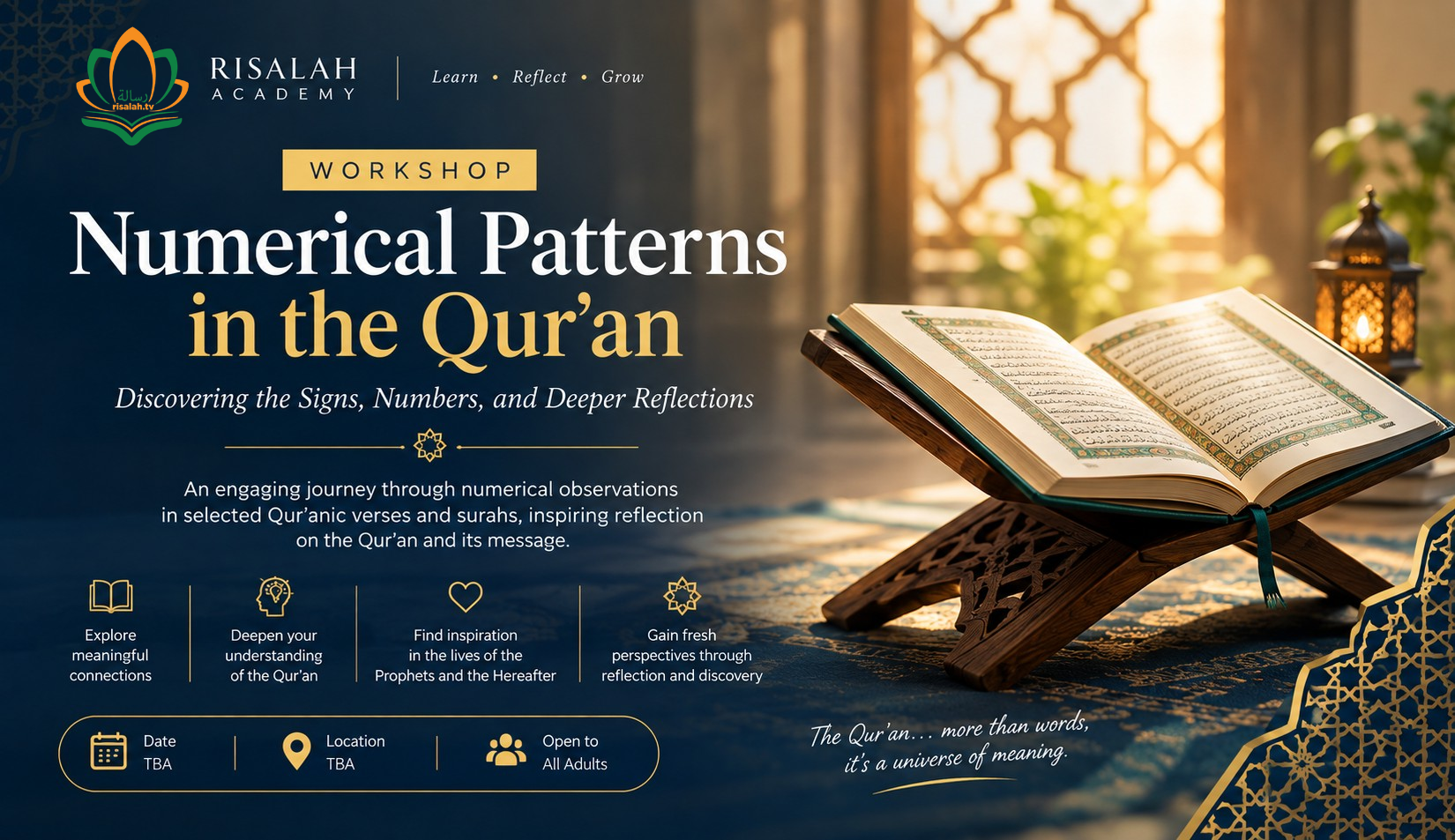
Numerical Patterns in the Qur’an
Discovering the Signs, Numbers, and Deeper Reflections
Clear, educational, and suitable for a broad Muslim audience. It invites exploration without making exaggerated claims.
8 chapters 8 lessons
The document connects three stages of the Prophet’s life—40 years before prophethood, 13 years preaching in Makkah, and 10 years in Madinah—to his age of 63.
The recurring verse, “Which of your Lord’s blessings will you both deny?” (55:13 and elsewhere), appears 31 times according to the document.
A computer count reportedly finds 504 occurrences of the three distinct Arabic letters in the name Muhammad (م، ح، د) throughout Surah Muhammad, excluding the opening Bismillah.
The study counts 10 words in the surah’s three verses. It also notes that the Arabic letter rā’ (ر) is the 10th letter in the modern Arabic alphabet
The document states that the Arabic word alwān (ألوان), meaning “colors,” occurs seven times across six verses.
Surah An-Naml is chapter 27 and has 93 verses.
The study counts the verses from Surah Al-Isra (17:50), where iron is mentioned, to Surah Saba (34:10), where Allah describes making iron pliable for Prophet Dawud عليه السلام.
In Surah Al-Kahf (18:25), the document examines the statement that the People of the Cave remained for 300 years and increased by nine.
Overview of the six studies
1. The Prophet’s ﷺ life and the number 63
The document connects three stages of the Prophet’s life—40 years before prophethood, 13 years preaching in Makkah, and 10 years in Madinah—to his age of 63. It then highlights the phrase “or We cause you to die” in three surahs: Ghafir (40:77), Ar-Ra’d (13:40), and Yunus (10:46).
2. Surah Ar-Rahman: 31 repetitions
The recurring verse, “Which of your Lord’s blessings will you both deny?” (55:13 and elsewhere), appears 31 times according to the document. These repetitions are divided into four sections: earthly blessings, warnings about Judgment and Hell, the first two gardens of Jannah, and two further gardens of Jannah. The proposed pattern is \(8+7+8+8=31\), associated with seven gates of Hell and eight gates of Paradise.
3. Surah Muhammad: 504 letters
A computer count reportedly finds 504 occurrences of the three distinct Arabic letters in the name Muhammad (م، ح، د) throughout Surah Muhammad, excluding the opening Bismillah. The document connects this result to \(63\times8=504\), representing the Prophet’s age and the eight gates of Jannah.
4. Surah Al-Kawthar: the number 10
The study counts 10 words in the surah’s three verses. It also notes that the Arabic letter rā’ (ر) is the 10th letter in the modern Arabic alphabet, and claims that the 10th dot in a count of the Arabic text falls on the word wanḥar (وَانْحَرْ), meaning to sacrifice. This is linked to Yawm al-Nahr, the 10th of Dhul-Hijjah.
5. The Qur’an and the seven colors of light
The document states that the Arabic word alwān (ألوان), meaning “colors,” occurs seven times across six verses. It connects this count with the seven traditional colors of the rainbow and refers to Newton’s prism experiment in 1666.
6. Surah An-Naml: the number 27
Surah An-Naml is chapter 27 and has 93 verses. The study claims that the opening letters Ṭā’ (ط) and Sīn (س) occur 27 and 93 times respectively. It also connects the ant’s appearance in verse 18 with the end of the Queen of Sheba narrative in verse 44: \(44-18+1=27\).
7. The miracle of iron: 1,538
The study counts the verses from Surah Al-Isra (17:50), where iron is mentioned, to Surah Saba (34:10), where Allah describes making iron pliable for Prophet Dawud عليه السلام. Its inclusive count is reported as 1,538 verses, matching the approximate melting point of pure iron in degrees Celsius: 1,538°C.
8. The People of the Cave: 300–309
In Surah Al-Kahf (18:25), the document examines the statement that the People of the Cave remained for 300 years and increased by nine. Beginning with the first occurrence of labithū in verse 12 and counting each word, including conjunctions separately, the study places the word mi’ah (مائة, “hundred”) at position 300 and another labithū at position 309, corresponding to \(300+9=309\).
Risalah.tv Academy
Teaches Numerical Patterns in the Qur’an at Risalah Academy. Open the teacher details to see their other courses.
Sign in to comment, enrol on a course, or pick up where you left off.
No account yet? Create one

Assalamu alaikum — how can we help? Ask about the broadcast, the academy or membership. We reply on WhatsApp.