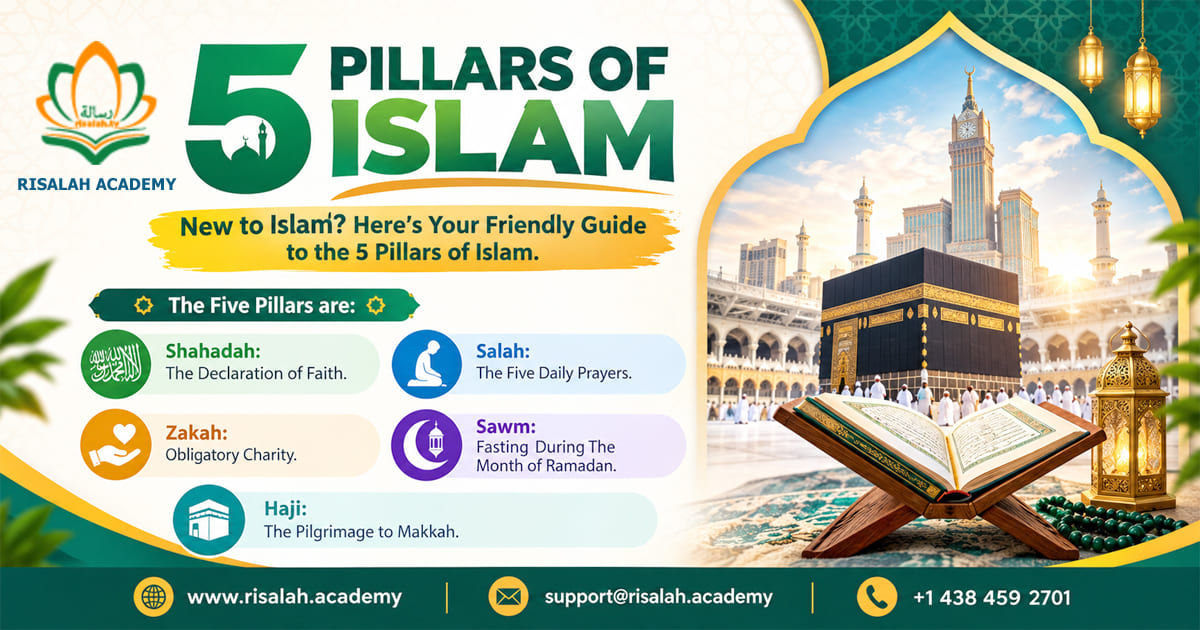
New to Islam? Here’s Your Friendly Guide to the 5 Pillars of Islam
Welcome! If you are reading this, you might be a new Muslim, someone seriously considering embracing Islam, or a curious friend trying to understand the faith of a loved one. First and foremost: welcome home.
Stepping into Islam or learning about it for the first time can feel incredibly exciting, but it can also feel a little overwhelming. You might be wondering: Where do I start? What is expected of me? Will I be able to keep up?
Take a deep breath. Islam is not designed to be a burden; it is a mercy. At the heart of this beautiful religion is a simple, supportive framework known as the Five Pillars of Islam. Think of these pillars not as a rigid checklist of rules, but as the load-bearing walls of a spiritual house. They are here to hold you up, give your life rhythm, and connect you directly to your Creator, Allah (God).
This friendly, comprehensive guide will break down the 5 Pillars of Islam in plain, easy-to-understand American English. We will explore what they are, why they matter, and how you can gently integrate them into your modern, busy life.
What Exactly Are the 5 Pillars of Islam?
In Arabic, the Five Pillars are called Arkan al-Islam. They are the core beliefs and practices that form the foundation of a Muslim’s life. Just as a physical house needs strong pillars to stand tall against the wind, a Muslim’s spiritual life relies on these five practices to remain stable, purposeful, and peaceful.
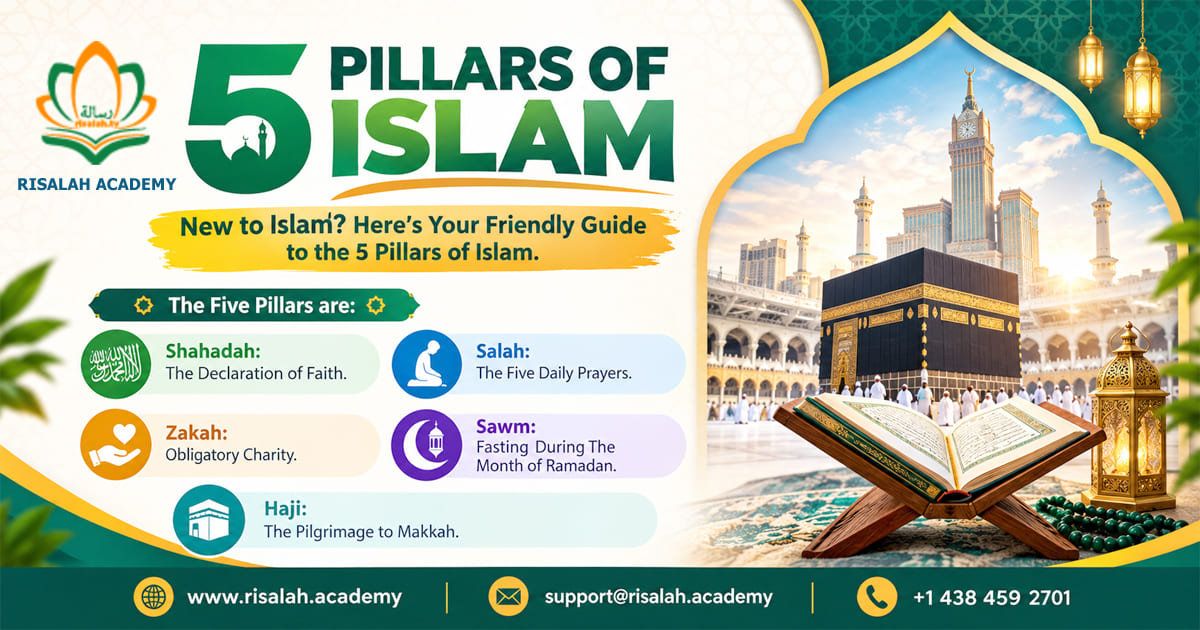
The Five Pillars are:
- Shahadah: The Declaration of Faith.
- Salah: The Five Daily Prayers.
- Zakah: Obligatory Charity.
- Sawm: Fasting during the month of Ramadan.
- Hajj: The Pilgrimage to Makkah.
Let’s walk through each pillar together, step by step, so you can understand the beauty and logic behind them.
Pillar 1: Shahadah – The Beautiful Foundation of Faith
The Core Concept:
The Shahadah is the absolute foundation of Islam. It is a simple, profound declaration:
"Ash-hadu an la ilaha illa Allah, wa ash-hadu anna Muhammadan Rasulullah."
Translation: "I bear witness that there is no deity worthy of worship except Allah, and I bear witness that Muhammad is the Messenger of Allah."
Why It Matters:
Before you can build anything, you need solid ground. The Shahadah is that ground. It introduces you to Tawheed, the central Islamic concept of the absolute Oneness of God. In a world that constantly asks us to worship money, status, careers, or even our own egos, the Shahadah is a liberating declaration of independence. It means you only answer to the One who created you.
When you truly internalize this, it brings immense mental clarity. You no longer have to chase the approval of society. Your worth is not determined by your job title or your bank account; it is determined by your connection to Allah.
For the Beginner:
If you are new to Islam, reciting the Shahadah with sincere belief is the exact moment you become a Muslim. It’s that simple. There is no complicated ceremony required. However, the Shahadah is not just a one-time phrase; it is a lifelong lens through which you view the world. Every time you make a decision, the Shahadah gently asks: Does this align with the guidance of Allah and His Prophet Muhammad (ﷺ)?
Pillar 2: Salah – Your Daily Spiritual Reset (Prayer)
The Core Concept:
Salah is the performance of five obligatory prayers every day: Fajr (dawn), Dhuhr (midday), Asr (late afternoon), Maghrib (sunset), and Isha (night).
Why It Matters:
Modern life is exhausting. We are constantly bombarded with notifications, deadlines, and stress. Modern psychology heavily promotes mindfulness, meditation, and taking regular breaks to prevent burnout. Islam prescribed this exact system over 1,400 years ago.
Salah is your daily spiritual reset button. It is a guaranteed, non-negotiable break from the chaos of the world to reconnect with your Creator.
- Fajr starts your day with peace and intention before the world wakes up.
- Dhuhr gives you a mental breather during the busiest part of your workday.
- Asr helps you reflect and re-energize as the afternoon winds down.
- Maghrib is a moment of profound gratitude for the day that has passed.
- Isha provides closure, allowing you to unload your worries and sleep with a peaceful heart.
Before praying, Muslims perform Wudu (ablution), which is the ritual washing of the face, hands, arms, head, and feet. This isn’t just about physical cleanliness; the cool water acts as a form of hydrotherapy, washing away the stress and minor frustrations of the day, preparing your mind for focused devotion.
For the Beginner:
If you are new to Islam, the idea of praying five times a day in Arabic might feel intimidating. Please do not panic. Allah judges you by your effort and your sincerity, not by your immediate perfection.
- Start small. Focus on learning one prayer at a time.
- Use a transliteration guide or a prayer app to help you pronounce the words.
- Remember that Salah is a conversation with Allah. Even if your Arabic is basic, your heart’s intention is what truly matters. Over time, the words will become familiar, and the movements will feel like a comforting, natural rhythm.
Pillar 3: Zakah – Purifying Your Wealth and Heart (Charity)
The Core Concept:
Zakah is the mandatory act of giving a fixed portion of your accumulated, unused wealth (typically 2.5%) to those in need, once a lunar year.
Why It Matters:
The word Zakah literally means "to purify" and "to grow." It is not a tax, and it is not just a nice thing to do; it is a spiritual purification process.
We naturally develop attachments to our money and possessions. This attachment can lead to greed, anxiety about the future, and a fear of scarcity. Zakah actively breaks that attachment. By willingly giving away a portion of what you have, you are declaring to yourself and to Allah: "My wealth does not own me. I am grateful for what I have, and I trust Allah to provide."
Psychologically, giving triggers a release of endorphins. Knowing that your contribution is feeding a hungry family, educating a child, or supporting a community brings a deep, lasting sense of contentment (Qana'ah) that buying material goods simply cannot match.
Zakah vs. Sadaqah:
It is important to note the difference between Zakah and Sadaqah. Zakah is the mandatory, calculated amount. Sadaqah, on the other hand, is voluntary charity. Sadaqah can be given at any time, in any amount, and it doesn’t even have to be money. Smiling at a stranger, helping a neighbor, or removing a hazard from the road are all beautiful forms of Sadaqah.
For the Beginner:
You do not need to calculate Zakah until you have reached a certain threshold of wealth (called Nisab) and have held it for a full lunar year. As a new Muslim, focus first on building the habit of Sadaqah (voluntary giving). As your financial stability grows, you can learn how to calculate and distribute your Zakah, perhaps using automated tools provided by trusted Islamic relief organizations.
Pillar 4: Sawm – The Spiritual Detox of Fasting
The Core Concept:
Sawm is the act of fasting from dawn until sunset during the holy month of Ramadan. During this time, Muslims abstain from food, drink, and marital relations.
Why It Matters:
We live in an era of instant gratification. If we are hungry, we order food. If we are bored, we scroll. We are rarely asked to delay our desires.
Ramadan is the ultimate spiritual and physical detox. By consciously denying the body its most basic needs for the sake of Allah, you prove to yourself that you are not a slave to your impulses. This builds Taqwa (God-consciousness and self-restraint).
But Sawm is not just about an empty stomach. The Prophet Muhammad (ﷺ) taught that if a person does not give up false speech and evil actions while fasting, Allah has no need for them to give up their food and drink. Therefore, fasting is also a masterclass in emotional regulation. It teaches you to control your anger, guard your tongue, and practice immense patience.
Furthermore, fasting levels the playing field. When you feel the pangs of hunger, you develop a visceral, heartfelt empathy for the millions of people around the world who go to bed hungry every night. This transforms abstract sympathy into active compassion and gratitude.
For the Beginner:
Ramadan only happens once a year for 29 or 30 days. It is a communal experience, making it much easier than fasting alone. The day is structured around two meals: Suhoor (a pre-dawn meal to give you energy) and Iftar (the meal to break the fast at sunset, often starting with dates and water, followed by community gatherings).
If you are new to Islam and Ramadan is approaching, know that Islam is a religion of ease. If you are ill, traveling, pregnant, nursing, or elderly, you are exempt from fasting and can make up the days later or feed the needy instead. Start by trying to fast for a few days, or even just half-days, to build your stamina. Your intention is what counts most.
Pillar 5: Hajj – The Journey of a Lifetime (Pilgrimage)
The Core Concept:
Hajj is the annual pilgrimage to the holy city of Makkah, in Saudi Arabia. It is a profound spiritual journey that every Muslim who is physically and financially able must undertake at least once in their lifetime.
Why It Matters:
While the first four pillars are integrated into daily or annual life, Hajj is the ultimate long-term spiritual goal. It represents the culmination of a Muslim’s faith.
The rituals of Hajj are deeply symbolic and date back to the time of Prophet Ibrahim (Abraham) and his family. The most striking aspect of Hajj is the state of Ihram. Male pilgrims wear two simple, unstitched white cloths, and female pilgrims wear modest, simple clothing.
In this state, all markers of worldly status are stripped away. A billionaire and a factory worker, a person of African descent and a person of European descent, stand shoulder to shoulder, circling the Kaaba (the sacred house of worship built by Abraham), reciting the exact same words: "Labbayk Allahumma Labbayk" (Here I am, O Allah, here I am).
This powerful visual dissolves ego, racism, and classism. It brings a profound sense of peace and unity, reminding every Muslim that in the eyes of Allah, we are all absolutely equal. Our only distinction is our piety and good character.
For the Beginner:
As a new Muslim, Hajj is likely not an immediate concern, and that is perfectly fine. Islam does not burden a soul beyond its capacity. The requirement is strictly tied to ability (health and financial means). For now, simply hold Hajj in your heart as a beautiful, long-term aspiration. Let it inspire you to save responsibly, maintain your health, and keep your spiritual record clean, so that one day, Allah may invite you to His house.
Practical Tips for New Muslims Navigating the 5 Pillars
Embarking on this journey is a marathon, not a sprint. Here are some friendly, practical tips to help you integrate the 5 Pillars into your life without burning out:
- Progress Over Perfection: Allah loves consistent, small actions more than occasional, overwhelming ones. If you can only manage two prayers a day right now, do those two with full focus and sincerity. Build from there.
- Find Your Community: Islam is deeply communal. Find a local, welcoming mosque or Islamic center. Having brothers and sisters who understand your journey and can answer your "silly" questions is invaluable.
- Leverage Technology: Use reliable, beginner-friendly apps like Muslim Pro, Pillars, or Athan to get accurate prayer times and Qibla (direction of prayer) notifications. Many of these apps also offer step-by-step prayer tutorials.
- Create a Dedicated Space: Designate a clean, quiet corner in your home or apartment for prayer. Having a dedicated prayer rug and a copy of the Quran with translation makes it much easier to transition into a worship mindset.
- Be Gentle with Yourself: You will make mistakes. You might miss a prayer, or struggle with a concept. That is completely normal. Allah is Ar-Rahman (The Most Merciful) and Al-Ghaffar (The Ever-Forgiving). Never let shaytan (Satan) convince you that you are "too sinful" to try again. Just repent, reset, and keep moving forward.
Deepen Your Journey with Risalah TV Academy
Understanding the concept of the Five Pillars is a fantastic first step, but truly internalizing their meaning, rules, and spiritual depth requires proper, structured guidance.
If you are looking to build a rock-solid, confident foundation in your faith, we highly recommend the "Islamic Fundamental: 5 Pillars" course offered by Risalah TV Academy.
This thoughtfully designed, four-session introductory course is specifically tailored for beginners, new Muslims, and anyone seeking to refresh their core knowledge in a supportive, easy-to-digest format.
Here is what you will learn in this transformative course:
- Class 01: Shahadah – The Foundation of Faith: Learn the profound, life-changing meaning of the testimony of faith, the concept of Tawheed (Oneness of God), and how believing in Allah and His Messenger (ﷺ) should actively and positively guide your daily decisions.
- Class 02: Salah – The Five Daily Prayers: Go beyond just the physical movements. Understand the spiritual importance of Wudu, the specific times and names of the prayers, and receive practical, actionable tips for developing a regular, sincere, and focused prayer habit.
- Class 03: Zakah & Sawm – Charity and Fasting: Discover how Zakah purifies your wealth and supports the broader community. Explore the deeper, transformative meanings of Ramadan fasting, including self-control, patience, gratitude, and the practical steps to building Taqwa (God-consciousness).
- Class 04: Hajj & Review: Learn the basic prerequisites and major practices of the Hajj pilgrimage, understanding its beautiful themes of obedience, sacrifice, and human unity. The class concludes with a comprehensive, interactive review of all Five Pillars to ensure you walk away with absolute confidence and clarity.
Learning Goal: By the end of this course, you will not only understand the Five Pillars of Islam intellectually, but you will also recognize their transformative importance in your faith, worship, and daily life.
👉 [Enroll in the Islamic Fundamental: 5 Pillars Course at Risalah TV Academy Today] and take the first, supported step toward a more structured, peaceful, and purposeful life.
Frequently Asked Questions (FAQs)
1. Do I have to do all 5 Pillars perfectly right away as a new Muslim?
No. Islam is a religion of gradual growth and mercy. Allah does not expect perfection on day one. Start with the Shahadah, then gradually build your prayer habit, and learn about the others at your own pace. Your sincere effort is what matters most.
2. What is the difference between Islam and Iman (Faith)?
Islam refers to the outward actions and practices (like the 5 Pillars), while Iman refers to the inward beliefs of the heart (like believing in Allah, His angels, His books, His messengers, the Day of Judgment, and Divine Decree). The 5 Pillars are the physical expression of your inward Iman.
3. How long does it take to learn how to pray (Salah)?
You can learn the basic physical movements and short chapters of the Quran to pray within a few weeks of consistent practice. However, perfecting the focus and connection (Khushu) in prayer is a lifelong journey. Be patient with yourself.
4. Can I pray in English if I don't know Arabic yet?
The obligatory parts of the prayer (like Surah Al-Fatihah) must be recited in Arabic. However, Islam is highly accommodating. While you are learning, you can use transliterations (English letters representing Arabic sounds). Many scholars also allow beginners to make their personal supplications (Dua) in English during the sitting portions of the prayer until they memorize the Arabic.
5. Is Zakah the same as paying taxes?
No. Taxes are paid to the government for public services and infrastructure. Zakah is a spiritual obligation paid to specific categories of people in need (like the poor, the needy, and those in debt) to purify your wealth and fulfill the rights of the community.
Conclusion
Embracing Islam is one of the most beautiful decisions you can make. The Five Pillars of Islam are not a heavy chain of restrictions; they are a divine blueprint for a balanced, meaningful, and peaceful life.
In a world that constantly pulls us in a million different directions, the Shahadah grounds your purpose, Salah resets your mind, Zakah purifies your wealth and heart, Sawm disciplines your desires, and Hajj unites you with a higher, eternal goal.
By embracing these pillars, you are actively designing a life of intention. You are choosing to live by a rhythm that honors your Creator and nurtures your soul.
Start small, be consistent, seek knowledge, and be gentle with yourself. Your journey toward a more structured and peaceful life begins with a single step, and you do not have to walk it alone. May Allah make it easy for you, bless your new journey, and grant you the profound peace that comes from true submission to Him.
Welcome to the family. We are so glad you are here.